Is Midtown Manhattan High-Rise Living Right for You?
June 18, 2026
June 18, 2026
Ever wonder why some buyers choose Midtown for a primary home when they could live somewhere quieter? The answer usually comes down to a very specific lifestyle: you are trading traditional neighborhood calm for speed, views, service, and near-instant access to the city around you. If you are considering a Midtown luxury high-rise, it helps to know what daily life actually feels like before you buy. Let’s dive in.
Midtown is not a classic residential neighborhood in the way many Manhattan buyers first imagine. It is a central business district shaped by zoning rules meant to support the city’s business core, improve pedestrian movement, and manage the impact of tall buildings on light, air, and street life.
That planning framework helps explain the feeling of the area. You are living in a place built around towers, transit, offices, entertainment, and constant movement. Residential life is part of Midtown, but it exists within a district designed to handle intensity at scale.
Midtown also has a smaller residential base than many other parts of Manhattan, even as that population has grown. A Manhattan Borough President report noted that the population in the area covered by Community Board 5 rose from 51,673 in 2010 to 63,600 in 2020, with residential units reaching 42,323. In plain terms, Midtown is increasingly lived-in, but it still feels unmistakably commercial and high-energy.
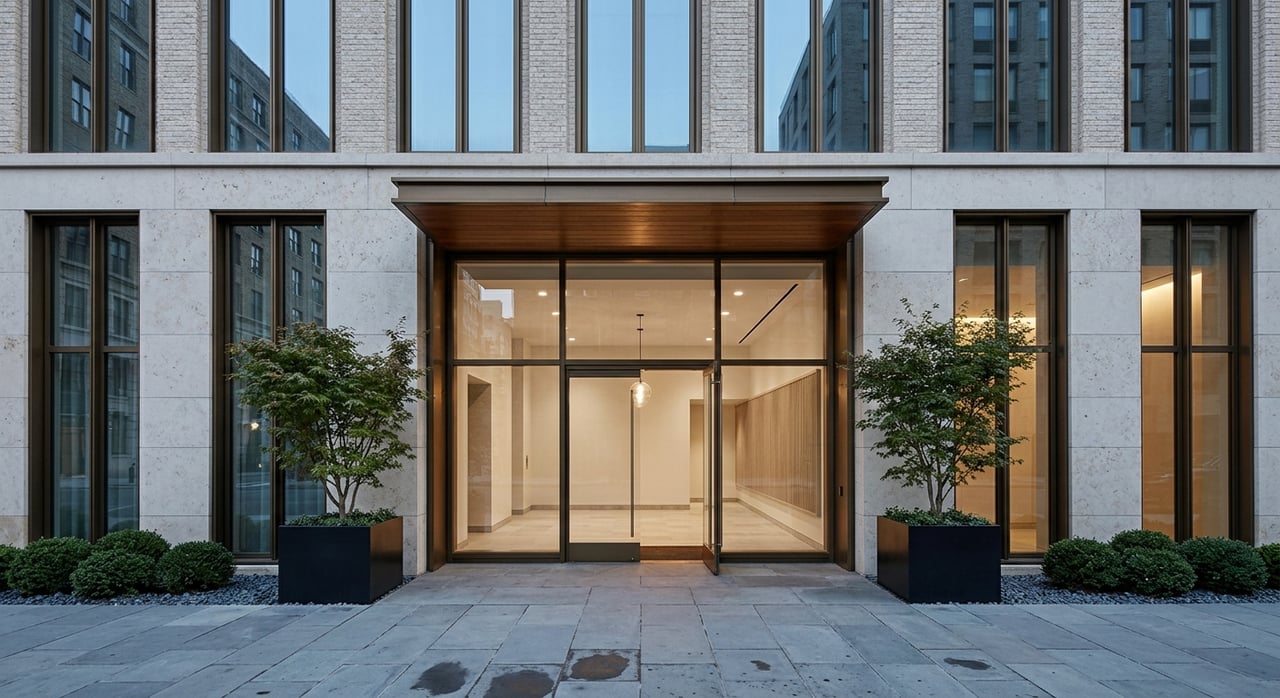
For many buyers, Midtown luxury living begins the moment you enter the building lobby. The experience often feels more like a private hotel than a conventional apartment house, with a strong focus on service, security, and separation from the street.
In high-profile Midtown towers, the apartment itself is often only part of the appeal. Official building marketing for towers like Central Park Tower and 53W53 emphasizes sweeping views, walls of glass, and elevated outlooks across the city. In many Midtown luxury buildings, the view is not a bonus. It is the main event.
That changes how the home feels day to day. Even when the sidewalks below are packed, your apartment can feel calm, quiet, and removed from the pace outside. The contrast between public street energy and private residential control is one of Midtown’s defining luxuries.
In many Midtown high-rises, height is part of the lifestyle. You may wake up above the street grid, watch light move across the skyline, and see landmarks from rooms framed by oversized windows.
That sense of elevation can make the home feel expansive even in a dense part of Manhattan. It also creates a visual connection to the city that is hard to replicate in lower-rise neighborhoods.
Luxury towers in Midtown also tend to emphasize hospitality-style amenities and staffing. Building marketing for leading towers highlights concierge service, resident lounges, pools, spas, fitness centers, and managed resident experiences.
For you as a buyer, that often means less daily friction. Packages, arrivals, guests, building access, and amenity use are typically handled within a more structured environment. If you value convenience and a polished routine, this can be a major part of the appeal.
One of Midtown’s biggest advantages is how simple it can make your daily movement. If you want a home base that keeps the rest of New York, and much of the region, within easy reach, Midtown is hard to match.
The MTA notes that virtually every subway line takes you to Midtown, with major nodes at Times Sq-42 St, Grand Central-42 St, 34 St-Penn Station, and 59 St-Columbus Circle. That level of connectivity affects everything from your commute to dinner plans to weekend logistics.
NYC Planning also notes that parking is not required in the Manhattan Core. That is more than a zoning detail. It reflects how transit-first the district really is, and why many Midtown residents can comfortably live with less dependence on a car.
Midtown is not just convenient within Manhattan. It is also one of the city’s strongest locations for regional travel.
Grand Central Terminal connects Metro-North, the Long Island Rail Road at Grand Central Madison, the subway, and multiple bus lines. That matters if your work, family, or second-home routines pull you toward Westchester, Connecticut, or Long Island.
Access to New Jersey is also unusually practical for a Manhattan address. PATH’s 33 Street station links Midtown with Jersey City and Hoboken, while the Port Authority Midtown Bus Terminal provides major bus connections and direct underground subway access.
Luxury high-rise living in Midtown can feel refined indoors, but the surrounding district is rarely quiet in a suburban sense. This is one of the most active parts of New York, and the pace of the neighborhood is something you should understand clearly before buying.
Community Board 5 describes Midtown as the city’s business, tourist, entertainment, and shopping core. It also contains major transit hubs and handles heavy pedestrian activity. In practical terms, that means sidewalks stay busy, streets stay active, and the neighborhood often feels switched on from early morning through late evening.
Construction is also part of the local reality. The New York City Department of Buildings notes that construction can be noisy, dusty, and disruptive, and city agencies track complaints and development activity by community district. In a place with steady building pressure, this is not a minor consideration.
If you are drawn to Midtown, it helps to frame the trade-off honestly. You are not choosing stillness. You are choosing access, convenience, and a high-service home in one of the city’s busiest environments.
For many buyers, that trade is worth it. The building creates a sense of order and privacy, while the neighborhood delivers speed and optionality the moment you step outside.
Another reason Midtown luxury living feels different is that so much is within walking distance. Your world can expand quickly without much planning, which gives the neighborhood a sense of immediate usefulness.
Bryant Park is Midtown Manhattan’s only large-scale public park and attracts more than 12 million visitors per year. Rockefeller Center offers a dense mix of dining and shopping across six blocks. MoMA sits in the heart of Midtown on 53rd Street, and the Times Square and Broadway corridor remains one of the city’s major theater and dining areas.
This concentration of destinations changes the rhythm of your week. A park break, a museum visit, a dinner reservation, a show, or a meeting can all fit into the same day without much travel time.
Midtown high-rise living is usually best for buyers who value efficiency more than neighborhood quiet. If you want direct transit access, elevated views, full-service building infrastructure, and fast proximity to culture and business hubs, Midtown can feel exceptionally convenient.
It can also work well if you split time between Manhattan and other parts of the region. Easy access to trains, buses, subways, and PATH can make a Midtown address feel practical in a way that goes beyond prestige.
On the other hand, if your top priority is a slower street atmosphere or a more traditional residential feel, Midtown may require a mindset shift. The luxury here often comes from control inside the building and proximity outside of it, not from a low-key neighborhood pace.
Before purchasing in a Midtown luxury tower, it helps to look beyond finishes and views. A strong buying decision usually comes from understanding how the building experience and neighborhood context work together.
Consider these questions as you compare options:
In Midtown, two apartments with similar square footage can feel very different depending on height, exposure, building operations, and distance from major transit flows. That is where careful, building-specific guidance matters.
If you are weighing Midtown against other central Manhattan neighborhoods, the key is not whether Midtown is objectively better. It is whether its combination of service, access, and intensity matches how you actually want to live.
When you are ready to evaluate Midtown condos with a clear strategy and building-level perspective, Sonal Patel can help you make a precise, well-informed decision.
Her experience, expertise, and engaging personality make Sonal the perfect combination of advisor, advocate, and strategist. She is the proud owner of several NYC properties and a skilled negotiator with a deep understanding of people and sharp instincts about market trends.